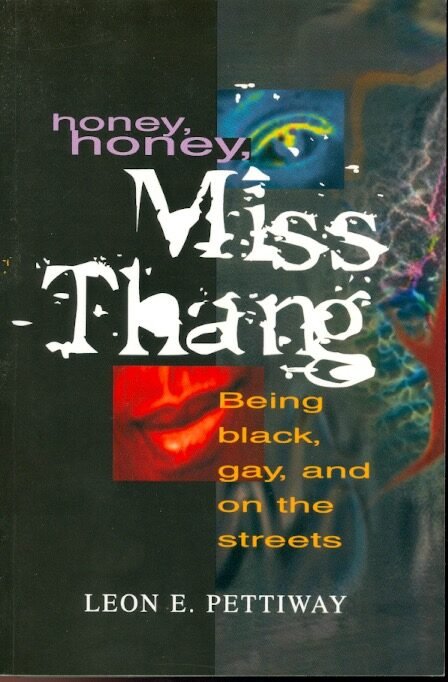
Honey, Honey, Miss Thang is one of the first books to chronicle certain aspects of living as a transgendered person. It must be remembered, however, that these interviews were conducted before the Transgender term was widely use or accepted in the black community, and as such, this book is one of the seminal books that reveal some of the intricacies of individuals who made their living on the streets to support their drug habits. And it should be remembered that this was also a time when some straight Americans would never embrace homosexuals as neighbors, co-workers, or friends. Still less would they accept as equals those transgendered individuals who worked the streets to provide themselves with drug money.
This book seeks to change that perception. It celebrates the lives of Shontae, China, Keisha, Detra, and Monique, five Afro-American hustlers who struggle to survive and to maintain a life of dignity and value in the face of their drug use and criminal activity. As individuals they vary in terms of background, the manner in which they entered the transgendered world, and the nature of their initiation into the drug subculture. None of them has escaped the ravages of urban decline, crime, drugs, and poverty that accompany life in an inner city, but by the same token, none of them has capitulated to the stresses with which they live.
It is impossible to read these accounts and not come away emotionally drained. As Monique explains, their lives take place in a world of chances. “You take a chance on living or dying, on being hurt or not being hurt, a chance on finding a friend or finding an enemy.” It is from this world that their voices speak so eloquently about their families, hustling, sexuality, sexual abuse, friendship, and intimacy.
The hope is that this book will evoke questions and encourage discussion so that we might re-think our assessments of those whom we have labeled “deviant.” Pettiway reaches beyond academic convention to offer a view with depth and emotion that mere statistics could never provide. While the poverty and often destructive lifestyle of these women may be gut-wrenching, their experiences reveal joy, pain, and the profound strength of the human spirit with which we can all identify. These lives have much to teach us about ourselves and those we label as “other.”